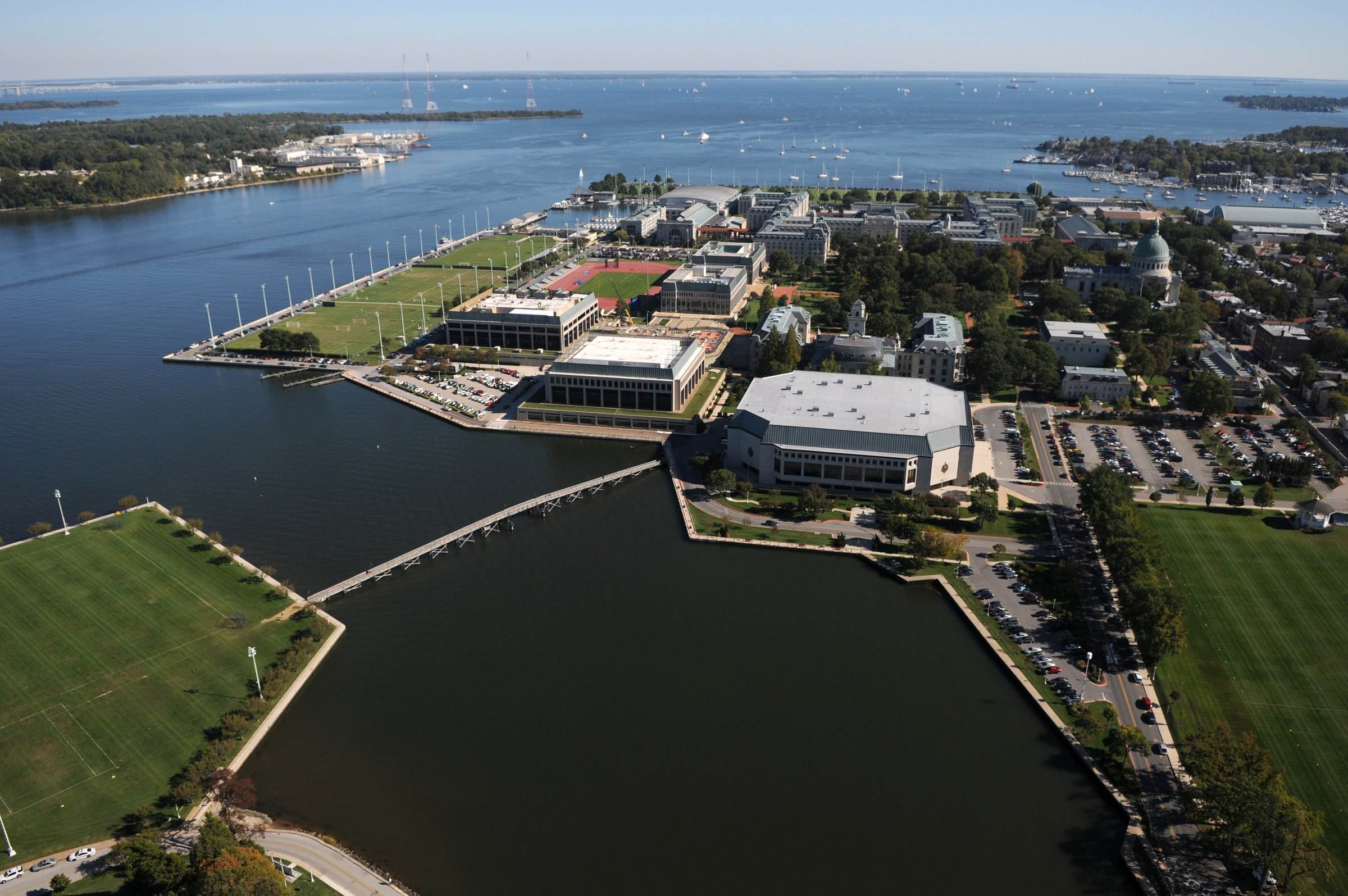


Aerial view of the Naval Academy grounds and the Severn River in Annapolis

USNA · Annapolis, Maryland

U.S. Naval Academy

A four-year college on the Severn River. Graduates become Navy ensigns or Marine Corps second lieutenants.

Navy and Marine CorpsDepartment of the NavyNomination: Required

The Naval Academy and the Severn River from the air, October 2012. Photo: U.S. Navy (National Museum of the U.S. Navy) via Wikimedia Commons, Public domain (U.S. government work).

A midshipman taking bearings aboard a Yard Patrol craft on the Chesapeake Bay
Midshipman training on a Yard Patrol craft, 2006. Photo: U.S. Navy photo by Photographer's Mate Airman Cale Hanie via Wikimedia Commons, Public domain (U.S. government work).
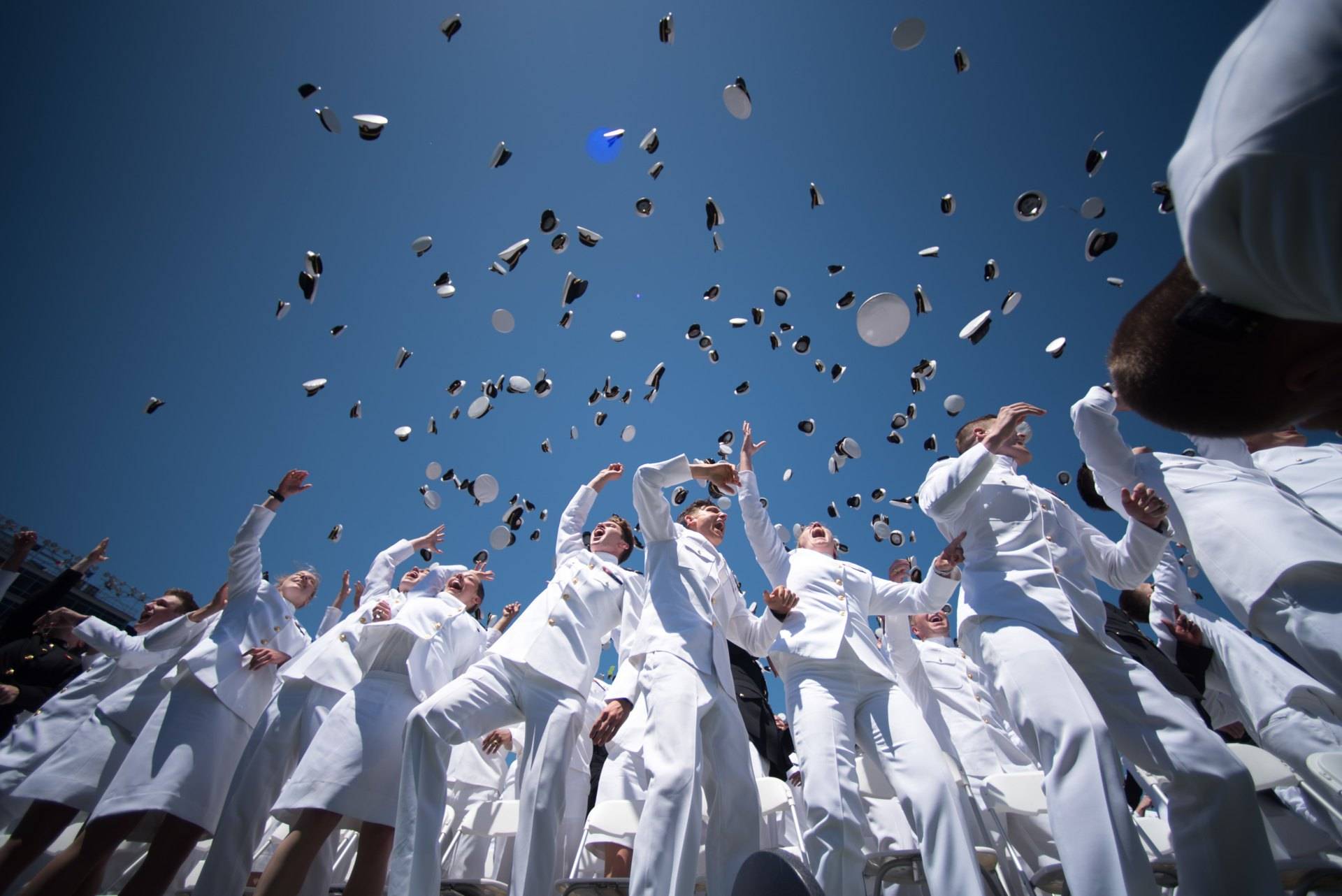
Naval Academy graduates throwing their covers in the air
2019 USNA graduation hat toss. Photo: Army Sgt. Amber Smith via Wikimedia Commons, Public domain (U.S. government work).
The dome of the U.S. Naval Academy Chapel seen from inside
Naval Academy Chapel dome, Annapolis. Photo: Acroterion via Wikimedia Commons, CC BY-SA 4.0.

At a glance

About 4,400 Midshipmen USNA Fact Sheet 2025–26
8:1 Student-faculty ratio USNA Fact Sheet 2025–26
NCAA Division I Athletics Primary conference: Patriot League · USNA PE Department
At least 5 years Service commitment USNA Fact Sheet 2025–26

Key takeaways

  • A nomination is required, usually from a member of Congress or the Vice President.
  • Plebe Summer starts on Induction Day and begins four years of military training.
  • Every midshipman plays a sport at the varsity, club or intramural level.
  • Graduates serve at least five years as Navy or Marine Corps officers.
  • High school juniors can apply to the Naval Academy Summer Seminar.

Drawn from the sourced guide below.

Admissions numbers

Official figures only. Each academy counts applicants its own way. All figures and definitions

8.8% Acceptance rate Calculated 16,077 applications started · 1,416 offers Class of 2029 · Offers ÷ applications started (1,416 ÷ 16,077) · USNA Class Portrait
16,814 Applications started Class of 2030 · usna.edu
1,204 Entering class Class of 2030 · usna.edu

Counts started, not completed, applications, so it runs lower than a completed-application rate would.

Class profile 6 measures · Class of 2030
MeasureValueClass
International students 14↗ Class of 2030
Geographic representation 49 states, plus DC, Guam, Puerto Rico, American Samoa and the U.S. Virgin Islands↗ Class of 2030
Children of alumni
i
11 have both parents who are USNA alumni.
73↗ Class of 2030
NAPS graduates
i
From the Naval Academy Preparatory School; 35 Navy and 7 Marine Corps of these are prior enlisted.
194↗ Class of 2030
Foundation or civilian prep
i
U.S. Naval Academy Foundation Program ÷ Civilian Prep Program.
49↗ Class of 2030
Prior enlisted
i
Navy 45, Marine Corps 11.
56↗ Class of 2030
Earlier classes 12 figures
MeasureValueClass
Applications started
i
Class Portrait 'Applications: Total'. The AEB report labels this 'Total applications initiated'.
16,077↗ Class of 2029
Fully qualified applicants
i
AEB AY24-25 report. The same report also gives '2600 fully qualified candidates' in its metrics table, which reads as rounded.
2,577↗ Class of 2029
Application completion rate
i
Percent of the candidate pool that completed an application. The number of completed applications itself is not published.
32.6%↗ Class of 2029
Offers of appointment 1,416↗ Class of 2029
Entering class
i
Inducted June 26, 2025 (per the 2029 Class Portrait PDF).
1,197↗ Class of 2029
Admit rate Calculated
i
Calculated: offers ÷ applications started = 1,416 ÷ 16,077 = 8.81%. The denominator counts started applications, so this rate is lower than an offers-to-completed-applications rate would be.
8.81%↗ Class of 2029
Yield
i
Published 'overall yield rate'.
84.6%↗ Class of 2029
Nominations by category
i
Published under 'Nominating Categories' without saying whether these count nominations or nominated candidates. They are not inductee counts. Do not add them up or compare them to the applications figure.
Congressional 5,614 · Presidential 486 · Secretary of the Navy 414 · ROTC/JROTC 340 · Children of deceased or disabled veterans 244↗ Class of 2029
Applications started
i
Men 10,287, women 4,859.
15,146↗ Class of 2028
Applications by sex Men 10,287 · Women 4,859↗ Class of 2028
Entering class
i
Projected class size as of June 26, 2024 (I-Day): men 814, women 373.
1,187↗ Class of 2028
Entering class by sex Men 814 · Women 373↗ Class of 2028

Class of 2031 dates

  1. Junior year of high school Preliminary application can start usna.edu · checked Oct 17, 2026
  2. Immediately after completing the preliminary application Request nominations usna.edu · checked Oct 17, 2026
  3. After March 1 of the year before entry – January 31 of the entry year Vice Presidential nomination window usna.edu · checked Oct 17, 2026
  4. After December 31 No new applications accepted (Class of 2031)Next up usna.edu · checked Oct 17, 2026
  5. January 31, 2027 Application must be complete; last ACT/SAT test date accepted usna.edu · checked Oct 17, 2026
  6. By April 15 Most candidates notified of final status usna.edu · checked Oct 17, 2026
  7. By May 1 Appointees accept or decline usna.edu · checked Oct 17, 2026
  8. TBD – verify Summer Seminar 2027 application opening Not yet posted usna.edu · checked Oct 17, 2026

Dates change. Confirm on the official admissions site. All academies’ deadlines

Summer program

Naval Academy Summer Seminar (NASS)

Current high school juniors

Sessions
June 5 – June 10, 2027 · June 12 – June 17, 2027 · June 19 – June 24, 2027
Apply
Application opens: TBD (per USNA)
Cost
$575 program fee

USNA says the Summer Seminar application also serves as your preliminary application to the Academy.

Source: usna.edu, checked Oct 17, 2026 · Compare all five

Overview

What it is
Founded as the Naval School in 1845, USNA is a four-year service academy that "prepares midshipmen morally, mentally and physically to be professional officers in the naval service"1.
Location and campus
338 acres between the south bank of the Severn River and downtown Annapolis, Maryland's state capital. Annapolis is 33 miles east of Washington, D.C., and 30 miles south of Baltimore. The campus is called the Yard. Bancroft Hall, the Chapel, and other century-old buildings make the Academy a National Historic Site1.
Students
About 4,400 midshipmen from every state, some U.S. territories, and several foreign countries1. All of them live in Bancroft Hall2.
Structure
The student body is the Brigade of Midshipmen: six battalions of six companies each, 36 companies in all. A first class midshipman, the Brigade Commander, leads it, and the Commandant of Midshipmen, an active-duty Navy or Marine Corps senior officer, oversees it2.
Class names
plebe or fourth class (freshman), youngster or third class (sophomore), second class (junior), and first class or "firstie" (senior)23.
Cost and pay
The Navy pays tuition, room and board, and medical and dental care. The Blue and Gold Book lists midshipman pay at $1,017.00 a month, with cash pay of $100 a month in the first year. That cash amount rises each year, and the rest is held for later expenses2. That page shows no date, so confirm current figures with USNA.
Honor
Under the Honor Concept, "Lying, cheating, and stealing are intolerable" and may be cause for separation2.
Class of 2029 snapshot
16,077 applications, 1,416 offers of appointment, and 1,197 midshipmen inducted on June 26, 20254.
  1. USNA Fact Sheet 2025–2026, PDF
  2. Blue and Gold Book: Life at USNA
  3. USNA Majors Listing
  4. USNA Class Portrait, Class of 2029

Mission

"The mission of the United States Naval Academy is to develop Midshipmen morally, mentally, and physically and imbue them with the highest ideals of duty, honor, and loyalty in order to graduate leaders who are dedicated to a career of Naval service and have potential for future development in mind and character to assume the highest responsibilities of command, citizenship, and government."1

Small wording difference: the Class of 2029 Class Portrait prints the mission with "to imbue" and slightly different punctuation2. We quote the Mission page above.

  1. USNA Mission
  2. Class Portrait PDF

Majors and academics

STEM focus
"the academic program is focused especially on science, technology, engineering, and mathematics (STEM)." For the Class of 2013 and later, at least 65% of graduates commissioned into the Navy must complete STEM majors1.
Degree
Every graduate earns a Bachelor of Science, regardless of major, "by law, due to the technical content of the core curriculum." The top 10% graduate with distinction1.
Majors offered (as listed on the Majors Listing page)
Aerospace Engineering; Arabic; Chemistry; Chinese; Computer Engineering; Computer Science; Cyber Operations; Data Science; Electrical Engineering; English; Foreign Area Studies; General Engineering; General Science; History; Mathematics; Mathematics with Economics; Mechanical Engineering; Naval Architecture & Marine Engineering; Nuclear Engineering; Ocean Engineering; Oceanography; Operations Research; Physics; Political Science; Quantitative Economics; Robotics and Control Engineering1. The page marks some majors as "no longer available to class of 2028." Its markers don't line up clearly with the names, so check the page for which ones.
How many majors? Official pages differ
The 2025–2026 Fact Sheet says majors are offered "in 23 subject areas: nine in engineering; ten in science, mathematics and computer science; and four in humanities and social sciences"2. The Majors Listing page shows more names than that, including ones being phased out1. We don't pick a number. Ask USNA, or see both pages.
Minors
French, German, Spanish, Russian, Japanese, Arabic, and Chinese1.
Faculty
Nearly 600, about half military and half civilian. Student-faculty ratio 8:1, with most classes of 10 to 22 students2.
Professional subjects
small arms, drill, seamanship and navigation, tactics, naval engineering, naval weapons, leadership, ethics, and military law2.
Choosing a major
"At the end of plebe year, midshipmen choose a major" with advice from academic and military advisors, but "the needs of the Naval Service take precedence"1.
  1. USNA Majors Listing
  2. USNA Fact Sheet

Athletics

Division and conference
USNA is an NCAA Division I school. "Its primary conference affiliation is with the Patriot League"1.
Football
Navy football joined the American Athletic Conference on July 1, 20152. Note: navysports.com is run by the Naval Academy Athletic Association, which USNA describes as a private non-profit that runs its intercollegiate program1. The Blue and Gold Book's athletics page is out of date here: it still says football "is scheduled to join" that conference in 20153.
Everyone plays
"All midshipmen are required to participate in these programs, either at the varsity, intramural or club level"3.
Varsity sports count: official pages differ
The 2025–2026 Fact Sheet lists 36 intercollegiate varsity sports (19 men's, 14 women's, 3 co-ed) plus 15 club sports4. The Blue and Gold Book lists 18 men's, 12 women's, and 3 co-ed3. The Fact Sheet is the newer, dated document. Confirm with USNA.
Activities
130 extracurricular activities4.
  1. USNA Physical Education Department
  2. Naval Academy Athletics, navysports.com
  3. Blue and Gold Book: Athletics
  4. USNA Fact Sheet

Service commitment and branch options

Commission
Graduates are commissioned as ensigns in the U.S. Navy or second lieutenants in the U.S. Marine Corps1.
Commitment
Graduates "serve at least five years" as officers1. Some career fields may require longer service. We did not find a USNA page listing those terms, so confirm with USNA or a Navy recruiter.
Career fields
22 Navy and Marine Corps career choices. The Class of 2026 had 796 Navy and 267 Marine Corps assignments, 1,063 in total2.
Starting pay
New ensigns and second lieutenants are paid at the O-1 rate, plus a food allowance and a housing allowance that depends on location. Current rates are in the official military pay tables3, which are updated every January.
  1. USNA Fact Sheet
  2. USNA News: Class of 2026
  3. DFAS: Pay Tables

Summer program for high schoolers

Naval Academy Summer Seminar (NASS)
for current juniors (rising seniors). It's a six-day session in Bancroft Hall. 2027 sessions: June 5–10, June 12–17, and June 19–241. The Summer Programs index page lists Session 1 as "June 5 – June 20," which doesn't match. Go by the Summer Seminar page and confirm with USNA2.
2027 application window
"opens TBD / closes TBD," not yet published1. For reference, the 2026 window was January 6 to March 31, 20263.
Fee
$575, covering lodging, meals, and clothing. Travel is the family's responsibility. About 800 spots per session, with rolling selection1.
It doubles as your application start
a Summer Seminar application counts as your USNA preliminary application4. Attending doesn't guarantee admission.
Younger students
Summer STEM is for rising 9th through 11th graders. 2027 sessions are June 7–12, June 14–19, and June 21–252.
  1. USNA Summer Seminar
  2. USNA Summer Programs
  3. USNA PAO
  4. USNA Apply

Rankings

Third-party opinions, not official academy data. They say nothing about your chances.

U.S. News 2027

  • #3 (tie) National Liberal Arts Colleges
  • #1 Top Public Schools (National Liberal Arts)
  • #4 (tie) Best Undergraduate Engineering Programs (doctorate not offered)

Publisher page: usnews.com. 2027 edition, checked Oct 18, 2026. Each rank compares schools within its own list.

Princeton Review 2027

Included in The Best 392 Colleges (2027 edition).

Best Value CollegesBest Mid-AtlanticTuition-Free Schools

Designations, not numbered ranks. Princeton Review profile, checked Oct 18, 2026.

Forbes’ 2027 America’s Top Colleges list doesn’t include the service academies, and Washington Monthly leaves them out by design. All rankings

Keep every USNA date on your calendar.

Coming soon: reminder emails before applications open, nomination deadlines close and summer program windows shut.